Self-watering planters to the rescue for councils, Britain in Bloom groups and gardeners

Despite some recent breaks in the dry weather, the hot summer of 2022 has been an ongoing topic of conversation. Love or hate the heat, it has thrown up its fair share of challenges. If you are farmer or a market gardener for example, the continuing dry weather is posing a significant threat to harvests and businesses.
The statistics make sobering reading, especially for the many who are alarmed by the prospect of climate change. Southeast England has had 144 days of little or no rain since the start of the year, and we are currently experiencing the longest dry period in 50 years according to the Met Office.
So, keeping floral displays fresh on the high street, in town squares and public spaces can be difficult. And whilst it may not be the most serious challenge that we are facing, these displays are important for public morale and local economies.
Watering once a week
This is where Amberol’s self-watering planters can help. All of our self-watering containers have a built-in water reservoir below the soil with a series of capillaries to ‘suck up’ the water which is then evenly dispersed via an expander pad. Because the water is stored under the soil, it doesn’t evaporate in warmer conditions. This means that even in the hottest, driest season, hanging baskets and containers need only be watered once or twice a week, saving on both water and maintenance.
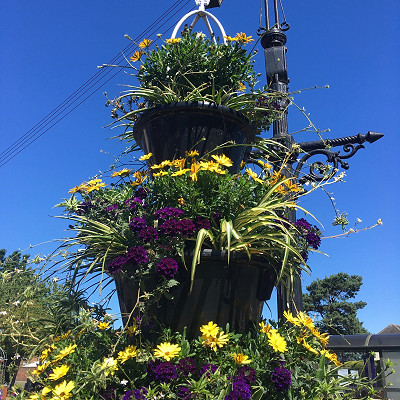
Ensuring optimal growth – even during a drought
Steve Parker, Commercial Manager at Amberol also explains some of the other benefits of using self-watering planters, saying: “The plants are able to access water and nutrients as and when needed, so using self-watering containers also helps to ensure optimal growth. This is particularly important during drought conditions. In fact, many of our customers are telling us how useful they have been during this extremely dry summer. As our seasons continue to get incrementally drier and warmer, the use of products such as self-watering planters are likely to become increasingly popular.”
Many councils, Britain in Bloom groups and gardeners were using self-watering planters to combat the dry conditions during the recent Britain in Bloom judging season which took place during July and August.
Draycott in Bloom in Derbyshire has been using Amberol planters for many years. Group volunteer Ali Bowley commented: We were extolling the virtues of Amberol’s self-watering planters to the RHS Britain in Bloom judges on their recent visit. We’re not sure where we’d be without them, especially this year. Adapting our planting to include more succulent plants combined with the use of self-watering planters has been a win-win situation regarding watering requirements this year.” (Photos courtesy of Draycott in Bloom.)
Introducing the hosepipe ban
England has had its driest July since 1935 with just 10% of the usual rainfall and drought conditions set to last until October according to the Centre for Ecology and Hydrology. Hosepipe bans are set to be introduced across many areas of south and central England as well as in Pembrokeshire and parts of Carmarthenshire in Wales. During a ban, people aren’t allowed to water plants and gardens although they are allowed to use a hosepipe for business purposes.
A sustainable solution
Made from recycled or recyclable polyethylene, Amberol’s self-watering planters are also a sustainable solution. Apart from reducing water waste from over running platers, the containers are notable for using our unique Aquafeed™ matting system. The range of self-watering planters include hanging baskets, large floor standing planters, wood effect barrels and tiered containers.
To find out more about Amberol’s self-watering technology or to arrange a no-obligation bespoke virtual demonstration, call 01773 830 930 or email sales@amberol.co.uk.