Giving your station a floral facelift.
Britain’s railway stations range from quaint and quiet Victorian stations through to flagship projects such as Birmingham’s busy New Street. But one thing they all have in common is the important part they play in the local economy and the communities they serve.
Once little more than glorified waiting rooms, most urban stations will include retail units and food outlets, while even the smaller stations are likely to have a coffee shop. Passengers may actually choose to spend time (and money) in stations, so it’s important to create the right environment.
Making a station look good is not just about making the platforms look pretty, it’s also an important commercial decision. However, money for beautification is not always readily available in these cash-strapped times.
One way of giving a station an immediate facelift is to introduce plants and flowers. A great floral display is relatively cheap to create, and can be an effective way of either brightening up a classic Victorian building or softening a modern, minimalist structure. One of the easiest and most economical ways of doing this is through the use of planters, which offer several advantages over traditional flowerbeds:
- They do not require any construction.
- They offer variety, from metre-square planters for smaller spaces to large fountain planters that create stunning centrepieces. You can use hanging baskets and barrier baskets for railings, to brighten up drab areas and create cascades of colour at different levels.
- They are portable. Of course, they need to be heavy enough to meet health and safety concerns, but they can be easily secured. And even larger containers can be moved using lifting equipment.
- They offer a more controlled environment - you can use whichever type of soil best suits your purposes. It’s also easier to reduce weeds and prevent damage from disease and pests.
However, while the larger stations may have sufficient staff to carry out planting and maintenance, many smaller stations simply don’t have the budget for this. Some of these smaller stations therefore rely on ‘adopter’ or ‘friend’ schemes, which encourage volunteers to help maintain their local station. This can range from raising funds for seating to planting floral displays, as well as reporting to the network on issues such as graffiti and vandalism.
For example, when Machynlleth station was judged best in Wales in the Keep Wales Tidy Awards in 2011, the initiative was supported by local girl guides and brownies groups, as well as by train drivers and conductors - they planted containers and introduced hanging baskets to improve the station’s appearance.
Arriva Trains Wales, Abellio Greater Anglia and ScotRail are just some of the networks that have found this type of initiative particularly popular in rural areas. They have also found it to be a useful way of maintaining station premises cost effectively.
In addition, community initiatives such as Britain in Bloom or In Your Neighbourhood groups often take local railway stations under their wing as part of their brief to improve the local environment.
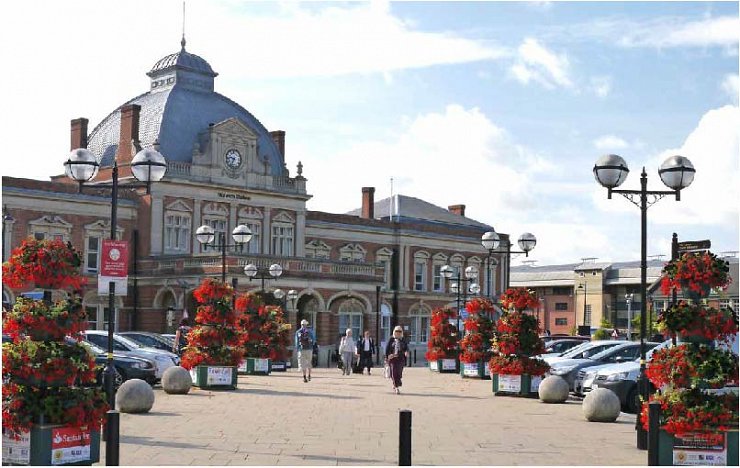
For example, work at Norwich has been a real community effort. The Friends of Norwich in Bloom group has installed large floral fountains to create an attractive entrance, as well as barrier baskets. The plants are grown by City College Norwich and a nearby nursery, while the group generates income though sponsorships, to sustain the maintenance and production of the plants However, whether using network staff, professional landscapers or volunteers, maintenance remains an issue in terms of both time and money.
One way that some stations have tackled this problem is by introducing self-watering planters. As these require watering no more than once a week, they conserve water as well as reducing maintenance time. They also create optimal growing conditions, making it easier to create beautiful displays. Furthermore, reducing watering frequency helps to address the health and safety issue of running long hose pipes along public areas.
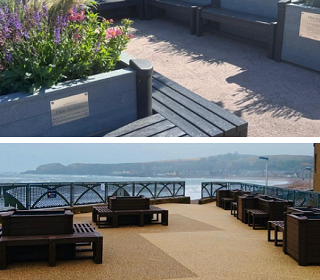
Many of the customers who we work with at Amberol have addressed the cost issue by implementing sponsorship schemes with local businesses. These schemes vary, but often involve companies contributing to the cost of container purchase or planting in return for a plaque on the container to mark their support. Not only are many businesses happy to support their community, they are also keen to be seen to be doing so. Plus, having attractive public areas such as stations is important for the local economy - they are often the gateway to a town or city for visitors.
Generally, containers are easy to plant and maintain. But there are some simple tips that can help the non-professional or inexperienced gardener to ensure success.
- Drainage - waterlogged plants don’t thrive, so ensure that containers have adequate drainage. Self-watering planters have drainage holes to prevent over-watering, and their specialised design means that plants areable to access moisture when needed. Our containers have a capillary action matting system that facilitates the dispersal of water only when required by the plant.
- Soil - container gardening is all about optimising growing conditions, so using the right soil is crucial for optimal growth. Most plants will grow in multi-purpose compost, but perennials and shrubs prefer loam-based compost, which is heavier and offers increased stability.
- Choosing the right container - there are many styles and sizes of containers on the market, made from a wide variety of materials. While aesthetics are important, there are
other factors to consider such as durability and maintenance.
Great strides have been made in the appearance of plastic containers, and there is a wide range of really attractive styles on the market. At Amberol we have developed planters that look like terracotta, wood and even stone to create an authentic heritage suitable for older stations, but which offer greater durability. With sustainability in mind, many planters are now made from recyclable polyethylene.
More traditional materials look good, but unfortunately many have flaws that give them a shorter shelf life. For example, ceramic and terracotta aren’t always frost-proof and can be prone to cracking. Wood rots over time unless regularly treated, while metal containers are susceptible to external temperatures, heating and cooling quickly.
- What to plant - most flowering plants thrive in containers. And with a variety of heights, sizes and styles available, it’s easy to create a stunning display.
Planting warm weather annuals ensures a long-lasting display - geraniums, marigolds, begonias, sweet pea, fuchsia and lobelia are all good choices. Dwarf cannas and dwarf dahlias are suitable for larger planters. Some rose varieties don’t grow well in containers, so it’s important to choose the right type such as a patio or miniature rose for ground cover. Roses need deep planters to accommodate their roots. Edible flowers such as marigolds and nasturtiums grow well in containers and make a great display.
Look around some stations, and it’s not difficult to see which ones are cared for - and that is an important message to send to customers, staff and potential tenants. The good news is it doesn’t have to cost a lot to create an impact with flowers - if you use the right materials.